

Four Conditions That Build Concentration
(In Children—and in All of Us)

After many years of observing children engaged in self-selected activities, I have come to understand something essential:
The ability to focus—and ultimately to concentrate—is not random.
Concentration develops when the conditions are right.
Dr. Maria Montessori identified four conditions that consistently support the development of attention, focus, and deep concentration. In my experience, these conditions are not only powerful for children—they benefit all of us.
When we create environments where concentration can flourish, something remarkable happens:
Concentration shifts from something we try to force through reminders, rewards, or pressure…into a natural process of learning and growth.
If we want to support meaningful work—whether in classrooms, homes, or workplaces—these four conditions are the place to begin:
Meaningful, self-selected activity
Uninterrupted time
Order and predictability
Freedom within limits of responsibility and safety
Let’s look at each one.
1. Meaningful, Self-Selected Activity
When an environment is filled with interesting and meaningful work, choice becomes the starting point of attention.
Attention develops into focus.
Focus, over time, deepens into concentration.
Well-designed activities—like those found in Montessori environments—are carefully matched to developmental levels. They spark curiosity while offering achievable challenges.
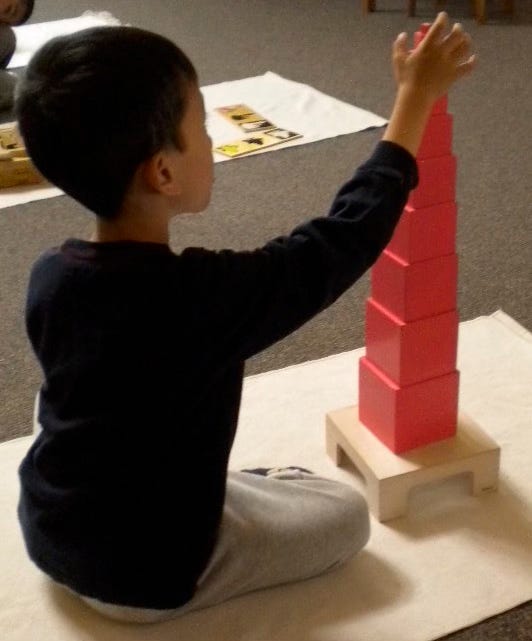
One well-known example is the Pink Tower.
A child is invited to carry ten cubes, one at a time, from a shelf to a workspace. Then comes the challenge: building the tower from largest to smallest.
At first, the work requires effort and coordination. But as the child repeats the activity, something shifts. Attention deepens. Movements become more precise. Focus strengthens.
Eventually, concentration begins to emerge.
The adult’s role is not to direct the process, but to protect it.
This means:
Minimizing interruptions
Observing carefully
Adjusting the level of challenge when needed
Each activity carries a clear purpose: take it, use it, return it. The environment itself invites engagement, but also provides structure.
Over time, repeated self-chosen work strengthens the child’s capacity for concentration—day by day.
2. Uninterrupted Time
Concentration is fragile, especially in its early stages.
If we want it to grow, we must protect time.
In Montessori environments, this protection takes a very specific form: long, uninterrupted work periods—often three hours or more.
During this time:
There are no whole-group interruptions
No forced transitions
No externally imposed task-switching
Children are free to follow their work.
What we observe is striking.
In the first part of the work period, children often choose familiar tasks. Gradually, their engagement deepens. Then, at a certain point, many will choose something more challenging—and stay with it for an extended period.
This is where concentration strengthens most.
There is also a second layer of time to consider: what we might call deep time.
In a well-prepared environment, children remain in the same setting for several years. The people, materials, and expectations are consistent. Skills build over time. Understanding deepens.
Concentration, like anything meaningful, is not built in a day.
It grows over years.
3. Order and Predictability
Order in the environment supports order in the mind.
When materials are consistently placed and logically arranged, learners are freed from unnecessary decision-making:
Where is this?
What comes next?
Instead, their energy can go toward the work itself.
Children are highly sensitive to order. They internalize the structure of their environment and use it to guide their actions.
This external order supports:
Clarity
Independence
Emotional regulation
Predictability matters as well.
Consistent routines, clear expectations, and materials with a defined beginning, middle, and end all contribute to a sense of stability.
In contrast, cluttered spaces and inconsistent routines create friction. They interrupt attention and make concentration harder to sustain.
We see this in our own lives, too.
When our environment is organized, we move through tasks with greater ease. When it is chaotic, even simple work becomes more difficult.
Order is not about perfection.
It is about creating conditions where the mind can settle.
4. Freedom Within Limits
Freedom is essential for concentration—but freedom alone is not enough.
For concentration to develop, freedom must exist within clear and consistent limits.
In a prepared environment, learners are free to:
Move
Choose their work
Engage at their own pace
But that freedom is balanced by responsibility.
For example:
Materials must be used carefully
Work must be returned to its proper place
Others’ work must be respected
A simple rule might be:
If someone is working, ask permission before interrupting.
These limits are not restrictive—they are protective.
They ensure that each person’s concentration can develop without disruption.
Without limits, the environment becomes chaotic.
With too many limits, the environment becomes controlled and restrictive.
In both cases, concentration breaks down.
The goal is balance:
Freedom that allows engagement
Limits that protect it
How the Four Conditions Work Together
These four conditions are not separate ideas. They are deeply interconnected.
Choice draws the learner into the work
Time allows concentration to deepen
Order removes unnecessary distractions
Limits protect the process
When all four are present, concentration begins to emerge naturally.
Not through force.
Not through reminders.
But through experience.
A Shift in How We Think About Focus
As parents, teachers, and leaders, we often find ourselves saying:
“Pay attention.”
“Focus.”
“Stay on task.”
“Finish your work.”
But over time, we begin to see:
Concentration cannot be commanded.
It cannot be produced through pressure or control.
It is the byproduct of a carefully prepared environment—one that offers meaningful choice, protects time, creates order, and establishes clear, respectful limits.
When these conditions are in place, something changes.
People don’t resist concentration.
They begin to seek it.
And in a world full of constant distraction, that may be one of the most important capacities we can help develop.
I invite you to download my Classroom Design Checklist for Autonomy and Concentration.
Even though it is geared for the classroom, it may be a helpful tool for home and work. Work, home or school—creating environments to strengthen concentration and independence works for both children and adults.
Join me for a complimentary mini-workshop…
